When do we use amount and when do we use number?
Julia C. from Walla Walla asks, “When do we use the word amount and when do we use the word number?” Here Thomas explains amount vs number by explaining count and non-count or mass nouns.

Julia C. from Walla Walla asks, “When do we use the word amount and when do we use the word number?” Here Thomas explains amount vs number by explaining count and non-count or mass nouns.

In the Intermediate Cozy Grammar Course, Marie and I help students develop their ability to look at any sentence and SEE what’s going on in it grammatically. While filming one of the new videos for the course this summer, we took time to make a quick and easy guide to getting started identifying the parts of a sentence.

To close out this month’s Ask Cozy Grammar session, Thomas reads a poem about learning from the 12th century Tamil woman, poet, and saint Avvaiyar and her book “Moothurai.”
Anays R. writes, “How to memorize verbs and moods, such as the conditional, imperative, indicative, interrogative, and subjunctive?” Here’s an answer from Thomas.

We’re delighted to announce the release of Marie Rackham’s Debussy & Me, 21 pieces of classical piano music to facilitate learning.

Debra H. from Montreal asks, “Where is Marie’s cozy beach cottage located?” Here Thomas explains not only where Marie’s cottage is located, but why she wanted to film Cozy Grammar there.

Here’s how to use a dash in a sentence—and why! Dashes can be one of the most confusing punctuation marks in the English language. Not even the experts agree on how to use them. This, however, is a good thing. It shows how the English language is constantly evolving. And there are some simple ways to use them.
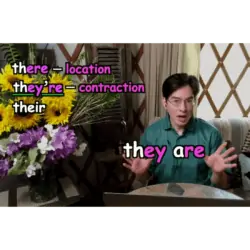
Let’s explore how to use apostrophes in contractions. Apostrophes are different from other kinds of punctuation marks. Unlike periods, commas, or question marks, for instance, an apostrophe becomes part of a word and can change its meaning dramatically.

Something students often find confusing is how to use an ellipsis in a sentence. We may see it employed all around us . . . and yet be uncertain how to use it ourselves. In the Basic Cozy Punctuation Course, Marie explores how to use the ellipsis as one of the four ways a period is used within a sentence.
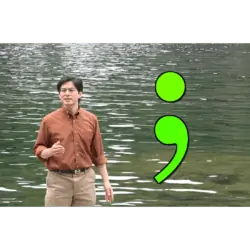
In the Basic Cozy Punctuation Course, one of the topics both Marie and I explore is how to use a semicolon in a compound sentence. Semicolons have a way of confusing young learners (and not-so-young learners) because their appearance can seem a bit confusing, but there’s a simple way to remember what they do.

One of the most common and confusing issues in English grammar is the difference between lay, lie, and laid. People can usually remember that there IS a difference, but most have trouble remembering what the difference is. Here Thomas shares a way to remember the difference between lay, lie, and laid for good.
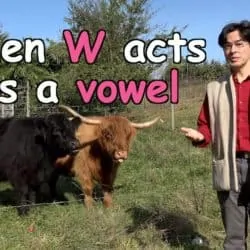
Andrew L writes, “How is W a vowel, as stated in “Marie’s Handy Guide to Spelling Rules?” Here is a step-by-step guide filmed on Plum Forest Farm that shows exactly when W is a vowel and when W is a consonant
When we start learning grammar, certain terms can feel intimidating. What is a principal clause? What is a compound sentence? Ideas like these can be confusing and can make students anxious. Yet knowing grammatical terms like these can help open the doors to excellence in writing and greater appreciation of beauty.
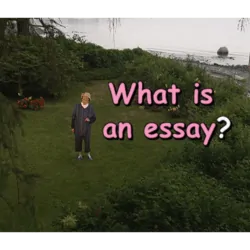
Whether you or your students are in school, homeschooling, unschooling, or just learning on your own, at some point you’re bound to face the question, “What is an essay?” Here’s Marie’s simple definition and a surprising second definition from Thomas. What is an essay? The powerful possibility of calmness.
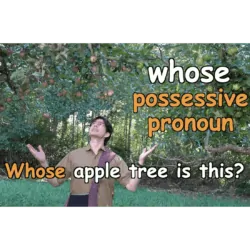
Even the brightest students of English grammar can become confused about whose or who’s. In fact, a student from Kahului, Maui, recently asked me to clarify the difference in an Ask Cozy Grammar video. After you take a peek, I’ll share three keys I’ve discovered to remembering grammar easily, keys you can easily use with your students.
A topic that can sometimes intimidate students (or their teacher or parents!) is how to use quotation marks in a sentence. Everything seems fine till you need to combine quotation marks with other kinds of punctuation marks, like periods and commas. Does the final period go inside or outside the quotation marks? Here’s our answer.