How To Determine Long Vowel Sounds
Audrine recently asked about how to determine long vowel sounds for an exercise in our Free Cozy Spelling Course. Check out this in-depth answer from Thomas. The key, he explains, lies in our ears.


Audrine recently asked about how to determine long vowel sounds for an exercise in our Free Cozy Spelling Course. Check out this in-depth answer from Thomas. The key, he explains, lies in our ears.

Dennis E. asks, “What is your teaching experience and background?” Here Thomas describes his experience with grammar and language, explaining how he brings his life’s work as a writer to his work for Cozy Grammar.

This question comes from Rosie C., writing from the UK. Rosie has asked a wonderful question about some of the exercises. In Lesson 9 of the Basic Cozy Grammar Course, we discuss the topic of singular versus plural verbs. What makes clings singular and cling plural? And what makes knocks singular and knock plural?

Anita C. from Garrettson, SD, asks, “What is the best way to make this course effective and yet run independently for my teen?” Here are three sets of suggestions that address each of these two things: the effective teaching—the effective learning—part of the question, as well as the independent part of the question—the honoring of independence.

Crystal from Belfast writes, “We don’t have a question in particular, but were curious to see how the Q & A sessions go, so we can be prepared for when we do have a question.” So here’s a brief overview as to how Ask Cozy Grammar works.
A student recently asked, “How do we rewrite a sentence without changing the meaning?” Here Thomas shares three simple tips for how to rewrite a sentence without changing the meaning but making it stronger at the same time.
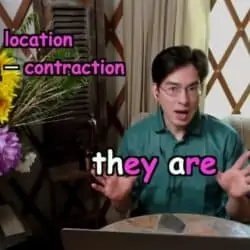
Thomas gives a simple way to remember the difference between there, their, and they’re. THERE has to do with WHERE. THEIR is a possessive pronoun like OUR and YOUR. THEY’RE always expands into THEY ARE. Remember this and you’ll always remember the difference.
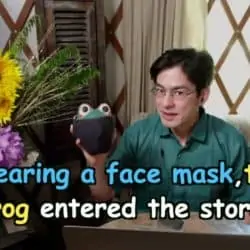
What is a dangling participle? Or modifier? Or participial phrase? These terms can appear quite confusing, but there’s a simple way to think about them. A dangling participle, modifier, participial phrase is simply a piece of description that isn’t clearly connected to what it’s describing.
Lewis W. asks, “What does verb tense consistency mean?” Here’s a simple and direct answer from Thomas and Ask Cozy Grammar.

A parent asks, “How do we get kids to write? How do you teach creative writing in primary school ages? Kids are always running from writing.” In this Ask Cozy Grammar session, Thomas suggests “writing out loud.”

Akshay from Malaysia asks, “Are there any tricks to remember grammar concepts?” In this quick introduction, Thomas explains three easy and effective ways to remember grammar rules.

Advay from Noida, India, asks, “How to learn prepositions?” In this quick introduction, Thomas gives examples of prepositions of time, place, and the secret preposition OF.

Taranindya from Indonesia asks, “How to Help Your Kids Love and Enjoy Grammar?” Here Thomas shares he gives three practical tips for helping young people not only understand but enjoy grammar and the study of language.

Thomas answers a question about how to encourage students and children to speak fluently and grammatically from an early age.

Juanita B. from Vancouver, BC, asks, “What is the different between then and than?” The secret is to remember that THEN has to do with TIME and THAN has to COMPARISON. If you remember the E in TIME and the A in COMPARISON, you’ll never confuse THEN and THAN again.

Taranindya asks, “What writing exercise can we use for practicing English grammar with a 9-year-old at home?” Here are some tips from Thomas.