How to Make my Child Love Spelling?
Sheena J. from Kerala, India, asks, “How to make my son love spelling?” Here’s an answer from Thomas on how important it is to center on the love.


Sheena J. from Kerala, India, asks, “How to make my son love spelling?” Here’s an answer from Thomas on how important it is to center on the love.

Colleen B. asks, “What happened to I SHALL and WE SHALL?” She’s referring to the distinction that was once taught between the first person use of SHALL and the second and third person use of WILL for the future tense. Here’s what Thomas has to say!

Leamon M. from New Orleans asks, “Can I use a plural and a singular together to express an understanding?” Here Thomas explores subject verb agreement, pronoun antecedent agreement, and using the singular and plural together.
Arcix from Australia asks, “Can you help me analyze the clauses in this sentence?” Here Thomas walks us through a complicated and interesting sentence.
Leamon M. from New Orleans asks, “Can I use a plural and a singular together to express an understanding?” Here Thomas explores subject verb agreement, pronoun antecedent agreement, and using the singular and plural together.
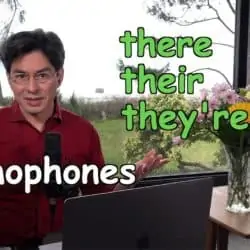
Jason J. from Cape Town, South Africa asks, “What is the difference between there, their, and they’re? It’s a bit confusing.” Here are three ways to remember the difference forever.

Liam from Meridian, Idaho, asks, “What part of speech is a number in a sentence?” Here Thomas explores how numbers sometimes serve as adjectives or determiners, and sometimes serve as nouns. It all depends on the context of the sentence.
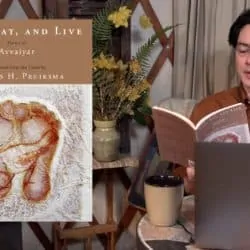
To close out this month’s Ask Cozy Grammar session, Thomas reads a poem about gratitude from the 12th century Tamil woman, poet, and saint Avvaiyar and her book “Moothurai.”

We’re delighted to announce the release of Marie Rackham’s Debussy & Me, 21 pieces of classical piano music to facilitate learning.

Wondering when to use anyone vs any one? Here, with the help of a madrona tree and some deer, Thomas explains the difference between anyone and any one.
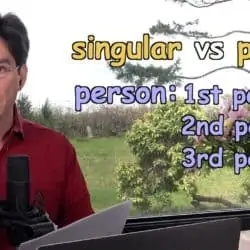
Awais from Pakistan writes, “The word ‘I’ is singular, but we use ‘have’ with it and not ‘has.’ Why is this?” Here’s a simple way to distinguish between singular and plural subjects, and first person, second person, and third person.
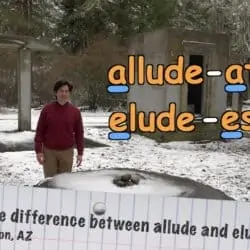
Wondering when to use allude vs elude? Here, in the middle of a snowstorm, Thomas explains the difference between allude, elude, and also the more unusual word illude.

Debra H. from Montreal asks, “Where is Marie’s cozy beach cottage located?” Here Thomas explains not only where Marie’s cottage is located, but why she wanted to film Cozy Grammar there.
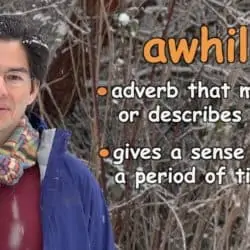
Wondering when to use awhile vs a while? Here, in the middle of a snowstorm, Thomas explains the difference between awhile, as an adverb, and a while, as a noun phrase.

Here’s how to use a dash in a sentence—and why! Dashes can be one of the most confusing punctuation marks in the English language. Not even the experts agree on how to use them. This, however, is a good thing. It shows how the English language is constantly evolving. And there are some simple ways to use them.

Jorge R. from Sacramento asks, “What is the difference between avocation and vocation?” Here’s a simple way to remember that an avocation is a hobby, while a vocation is a calling.